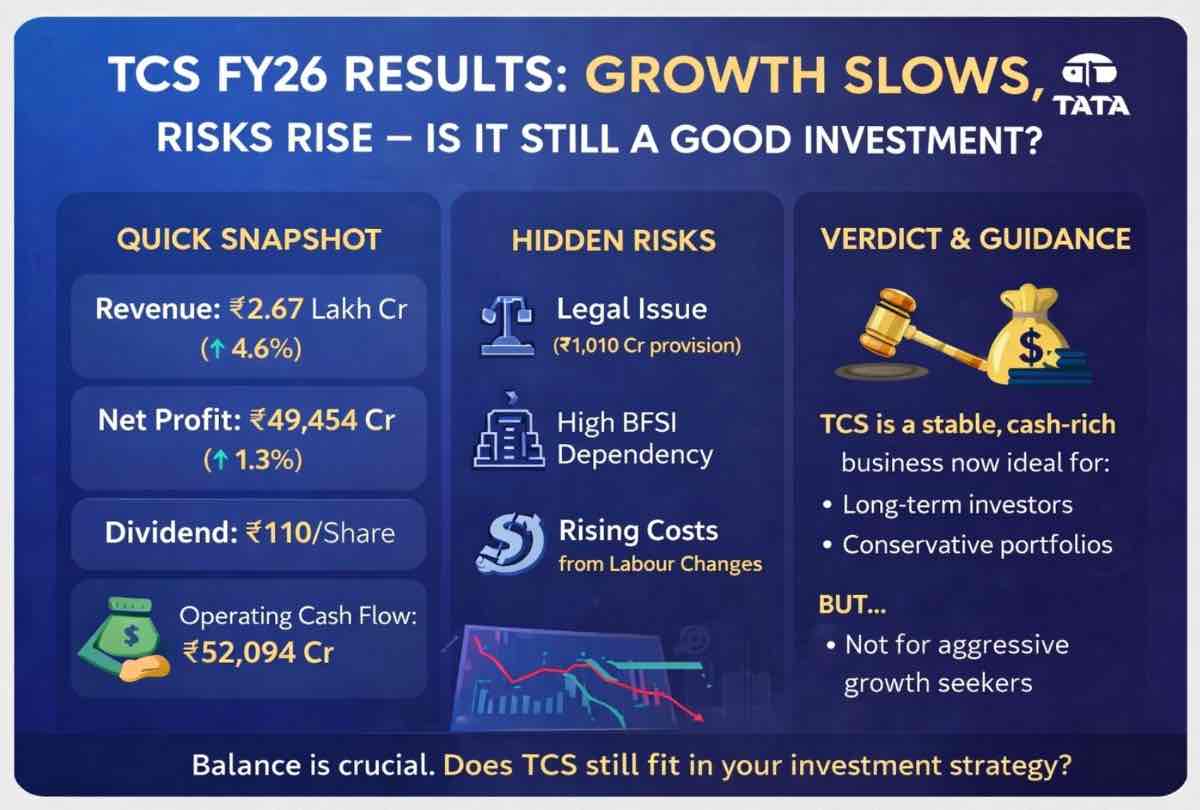
TCS has announced its FY2026 results.
Table of Contents
At first glance, everything looks fine. Revenue is growing, profits are stable, and dividends are strong; exactly what you expect from a company like TCS.
But when you go a layer deeper, the picture becomes more interesting.
Let’s simplify what’s really happening.

TCS Results FY26 – Quick Snapshot
- Revenue: ₹2.67 lakh crore (up ~4.6%)
- Net Profit: ₹49,454 crore (up ~1.3%)
- Dividend: ₹110 per share
- Operating Cash Flow: ₹52,094 crore
On paper, this looks like a solid year.
But as always in investing, the trend matters more than the number.
So What’s Changing?
Growth is clearly slowing
TCS used to comfortably grow in double digits. That’s no longer the case.
Now we’re looking at approximately 4% to 5% growth. Not bad; but very different from what many investors still expect. And this is despite the depreciation of Indian Rupee against the Dollar.
From what I see, this is largely because:
- Global IT spending is slowing
- Clients are taking longer to make decisions
- Budgets are being used more cautiously
TCS is not facing a crisis. It’s simply entering a more mature phase.
Profit is not keeping up with revenue
This is something many people miss.
Revenue grew around 4.6%, but profit increased only about 1.3%.
That gap tells you one thing; margins are under pressure.
Main reasons:
- Employee costs continue to rise
- There were some large one-time expenses this year
This is not alarming, but it’s definitely worth paying attention to.
One-time impact was significant this year
There were a few exceptional items that impacted profits:
- Labour-related changes: ₹2,128 crore
- Legal provision: ₹1,010 crore
- Restructuring costs: ₹1,388 crore
That’s more than ₹4,500 crore in total.
Now, these are mostly one-time in nature. But they still affect how the numbers look — and more importantly, how the market reacts.
Risks You Should Not Ignore
Legal case uncertainty
TCS has already provided ₹1,010 crore for a legal matter.
The final outcome is still not fully clear. If things don’t go in their favour, the liability could increase.
Not a deal-breaker — but something to track.
Heavy dependence on BFSI
A large chunk of TCS revenue comes from banking and financial services.
This has always been a strength.
But it also means that if this sector slows down globally, TCS will feel the impact.
Cost structure is rising
With labour law changes and restructuring, costs are clearly going up.
Over time, this could put pressure on margins if growth doesn’t pick up.
What TCS is Doing Right
This is important; because the company is not standing still.
TCS is investing heavily in:
- Cloud
- AI
- Digital transformation
- Salesforce ecosystem
Acquisitions like Coastal Cloud show that they are positioning themselves for the next phase of growth.
That’s exactly what a strong management team should do.
Why TCS Still Remains a High-Quality Business
Even after all this, TCS remains one of the strongest companies in the market.
- Consistent cash generation
- Almost debt-free
- Strong return ratios
- Market leadership
- Reliable dividends
Very few companies can offer this level of stability at scale.
Should You Invest in TCS Today?
This is where clarity matters.
TCS makes sense if you are:
- A long-term investor
- Someone who values stability
- Building a disciplined portfolio
- Looking for consistent, predictable returns
It may not be ideal if you are:
- Chasing high growth
- Looking for quick gains
- Expecting multibagger-type returns
That phase of TCS is likely behind us.
Final View on TCS Results
TCS is no longer a high-growth story.
It has evolved into something else — a stable compounder.
A business that:
- Generates strong cash
- Rewards shareholders
- Grows steadily, even if not aggressively
And there is nothing wrong with that.
In fact, most portfolios need this kind of stability.
One Last Thought on TCS Results for FY 26
In my experience, most investors don’t go wrong because of one bad stock.
They go wrong because they don’t build the right mix.
TCS can play an important role in a portfolio — but only if it’s used correctly.
That balance is what actually drives long-term results.
If you’re trying to build a portfolio that gives you both growth and peace of mind, focus less on “which stock” and more on how everything fits together. If your goal is peace of mind, mutual funds usually offer a more stable and diversified approach compared to individual stocks.
That’s where real investing starts.
You can find the official TCS results on their website.
None of the information presented above should be construed as investment advice. The content is intended solely for informational and educational purposes and does not constitute a recommendation, endorsement, or solicitation to buy or sell any securities or financial instruments. Investment decisions should be made based on your individual financial goals, risk tolerance, and after consulting with a qualified financial advisor.